
Operational analytics
Bring device and business data into a clearer view of activity, trends, and exceptions. Define the signals that matter to the people using the system.
AI integration & analytics / Applied intelligence
Connect AI to a defined operational problem, the data you have, and the people who need a clearer answer.
Information and a business question meet in an intelligence layer, producing a response a person can review.
The business context
AI earns its place when it helps someone understand a situation, find information, or make a better-informed decision.
We begin with the workflow and the quality of the available data. From there, we can define where analytics, conversational interfaces, or model integration belong—and how the result will be evaluated.
Where we can help
Choose a practical starting point. Build the data and application connections around it.
Bring device and business data into a clearer view of activity, trends, and exceptions. Define the signals that matter to the people using the system.
Make information easier to access through a focused conversational experience connected to the right business systems.
Connect intelligence to IoT data and operational applications, keeping the path from a reading to a response visible.
Bring AI output into an existing workflow through software interfaces, dashboards, or alerts. Keep human review where the decision needs it.
Industrial IoT analytics starts with reliable device signals. Connect embedded systems, gateway data, and cloud applications before deciding where an intelligence layer can be useful.
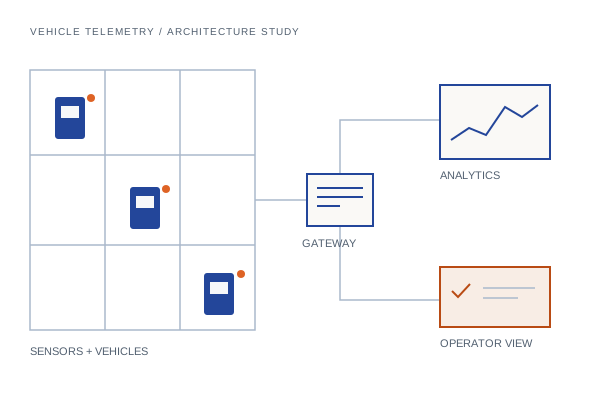
Architecture study of the published vehicle-analytics work, showing the data connections that can support an intelligence layer.
Related engineering foundation
CoreSoftTech’s vehicle analytics work connects sensor readings, gateways, cloud data, and operational dashboards—the kind of foundation an intelligence layer needs.
How we start
Bring your current environment and the outcome you’re working toward. We’ll use that context to shape the first stage.
Let’s find a starting pointClarify the business need, who the system serves, the constraints, and what a useful result would look like.
Review the data, devices, applications, and infrastructure involved. Identify dependencies before choosing the approach.
Agree on a focused scope, how the work will be evaluated, and the operational responsibilities that follow.
Before we begin
No. A well-defined use case is a practical starting point. We can discuss the workflow, available data, operating constraints, and how you would judge whether the result is useful.
Integration should be part of the initial assessment. We look at the applications, interfaces, data access, and security requirements before deciding how a new capability fits.
Agree on the intended task and evaluation approach before building. Depending on the use case, this may include the quality of an answer, the usefulness of an alert, or how well an interface supports a real workflow.
The wider connection
U.S. presence / Since 2011
From Plainsboro, New Jersey, to Sunnyvale, California, we bring an established U.S. presence to your next technology project. Start with a direct conversation.
West Coast office
100 S. Murphy Avenue, Suite 200Let’s find a starting point
Tell us a little about your project and when you’d like to talk.