
Embedded software
Develop the software that reads a device, handles local logic, and communicates with the rest of the system. Work within the constraints of the selected hardware.
IoT development / Embedded systems engineering
Bring devices, embedded software, gateways, and cloud applications together around the realities of your operating environment.
A field device connects to edge and cloud processing, then to an operational response. Illustrative architecture, not live data.
The business context
The connection has to work beyond the lab: with the hardware, network, environment, and people involved in day-to-day operations.
Our documented IoT work spans vehicle analytics, environmental monitoring, gateways, and connected control. We bring those layers into one engineering conversation, from the first device reading to the application that uses it.
Where we can help
Consider the full path early, so device and application decisions support each other.
Develop the software that reads a device, handles local logic, and communicates with the rest of the system. Work within the constraints of the selected hardware.
Connect sensors, devices, and applications through gateways and appropriate communication protocols. Account for how and where the equipment operates.
Turn device readings into dashboards, alerts, and interfaces that help operators understand activity and conditions.
Bring device data into cloud infrastructure and business applications, with the supporting data flow and operational considerations defined upfront.
Device-to-cloud integration brings readings into operational applications. Cloud engineering supports the infrastructure; applied AI and analytics can help people interpret the information.
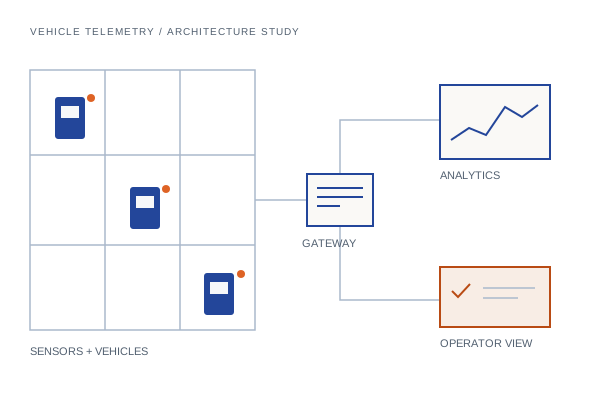
Architecture study based on the published project description. Original documentation describes deployment in indoor transportation and warehouse settings.
Documented project / Vehicle analytics
A vehicle analytics and telematics solution developed from proof of concept to product, connecting Bluetooth sensors and an ARM-based gateway with cloud analytics.
How we start
Bring your current environment and the outcome you’re working toward. We’ll use that context to shape the first stage.
Let’s find a starting pointClarify the business need, who the system serves, the constraints, and what a useful result would look like.
Review the data, devices, applications, and infrastructure involved. Identify dependencies before choosing the approach.
Agree on a focused scope, how the work will be evaluated, and the operational responsibilities that follow.
Before we begin
Yes. A proof of concept can test the device, data flow, communication, and intended interface against a defined operating scenario before committing to a wider deployment.
That depends on the device interfaces and available documentation. The first assessment should establish what can be read or controlled, how it communicates, and what limitations need to be addressed.
A description of the environment, the devices or equipment involved, the information you need, and what action that information should support. Existing diagrams and technical documentation are useful if available.
The wider connection
U.S. presence / Since 2011
From Plainsboro, New Jersey, to Sunnyvale, California, we bring an established U.S. presence to your next technology project. Start with a direct conversation.
West Coast office
100 S. Murphy Avenue, Suite 200Let’s find a starting point
Tell us a little about your project and when you’d like to talk.