
Business applications
Plan and build software around a defined operational task, including the roles, permissions, records, and exception paths it needs.
custom software development / Business technology
Custom software development for business workflows, internal tools, and enterprise applications. Connect requirements, integrations, and a practical delivery plan.
Workflow rules, integrations, and business records form an application, with a review loop back to its users.
The business context
Custom software development for business workflows, internal tools, and enterprise applications. Connect requirements, integrations, and a practical delivery plan.
Start with the work that an existing tool cannot support. Map the users, business rules, and system dependencies, then define an application that fits the process and can be maintained after launch.
Where we can help
Shape the scope around your current environment, users, and the work that needs to improve.
Plan and build software around a defined operational task, including the roles, permissions, records, and exception paths it needs.
Replace repeated handoffs and manual data entry with an application flow that makes responsibility and status visible.
Assess an existing application and identify bounded improvements to its interfaces, structure, and integrations while accounting for current users.
Agree on acceptance criteria, review working increments, and document the application and operational responsibilities for the receiving team.
A business application often needs a web interface, integration with existing systems, and a cloud environment. Plan these dependencies alongside the workflow rather than after the screens are designed.
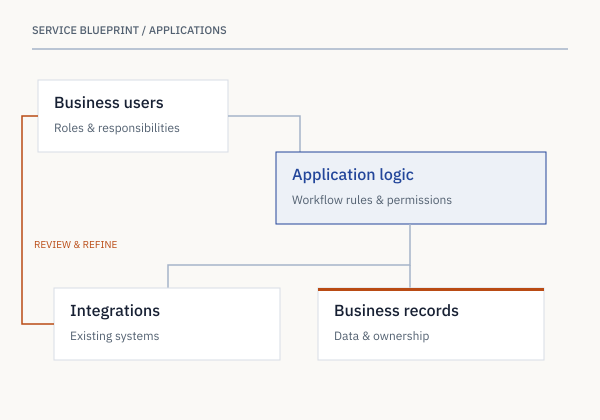
Illustrative engagement model, not a client case study. Scope and delivery responsibilities are agreed for each project.
Illustrative engagement / Custom software development
A business application often needs a web interface, integration with existing systems, and a cloud environment. Plan these dependencies alongside the workflow rather than after the screens are designed.
How we start
Bring your current environment and the outcome you’re working toward. We’ll use that context to shape the first stage.
Let’s find a starting pointClarify the business need, who the system serves, the constraints, and what a useful result would look like.
Review the data, devices, applications, and infrastructure involved. Identify dependencies before choosing the approach.
Agree on a focused scope, how the work will be evaluated, and the operational responsibilities that follow.
Before we begin
Begin by comparing the workflow, required integrations, ownership, and ongoing cost. Custom development is appropriate when the important requirements cannot be met adequately by an existing product.
An initial assessment can review the application, documentation, dependencies, and maintenance constraints. That establishes whether to improve a bounded part, replace a component, or plan a wider change.
Choose one useful workflow with named users and clear acceptance criteria. Include the data, permissions, and integrations required for that workflow to operate, then prioritize further work from feedback.
The wider connection
U.S. presence / Since 2011
From Plainsboro, New Jersey, to Sunnyvale, California, we bring an established U.S. presence to your next technology project. Start with a direct conversation.
West Coast office
100 S. Murphy Avenue, Suite 200Let’s find a starting point
Tell us a little about your project and when you’d like to talk.