
Current-state assessment
Review the applications, data flows, devices, and infrastructure involved in a defined problem. Record dependencies and operational constraints.
IT consulting services / Business technology
IT consulting and technology planning for applications, connected systems, and cloud infrastructure. Assess the current environment and define a practical delivery roadmap.
Assess the current environment, compare options, and prioritize a delivery roadmap. The sequence does not imply a fixed project schedule.
The business context
IT consulting and technology planning for applications, connected systems, and cloud infrastructure. Assess the current environment and define a practical delivery roadmap.
An architecture review should help a business make a decision. Connect current systems and operating constraints to the intended outcome, then compare the viable approaches and the work each requires.
Where we can help
Shape the scope around your current environment, users, and the work that needs to improve.
Review the applications, data flows, devices, and infrastructure involved in a defined problem. Record dependencies and operational constraints.
Map responsibilities across components and teams. Identify important interfaces and the decisions that need evidence before implementation.
Compare approaches against business needs, maintenance responsibilities, integration requirements, and delivery constraints.
Turn the assessment into prioritized work, a bounded first delivery, and clear evaluation criteria for any prototype or proof of concept.
Technology planning brings application, AI, IoT, and cloud decisions into the same conversation. A focused assessment can identify which discipline should lead and where another team or system needs to be involved.
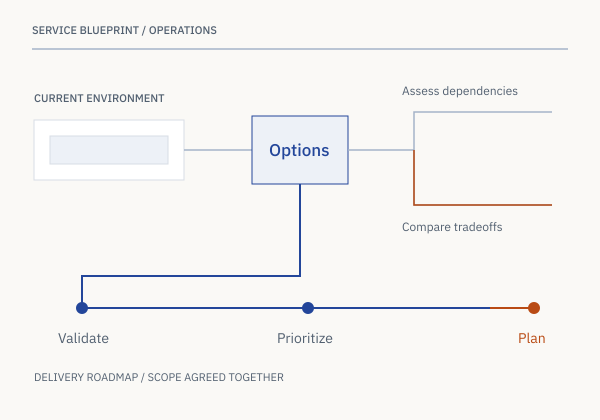
Illustrative engagement model, not a client case study. Scope and delivery responsibilities are agreed for each project.
Illustrative engagement / IT consulting & technology planning
Technology planning brings application, AI, IoT, and cloud decisions into the same conversation. A focused assessment can identify which discipline should lead and where another team or system needs to be involved.
How we start
Bring your current environment and the outcome you’re working toward. We’ll use that context to shape the first stage.
Let’s find a starting pointClarify the business need, who the system serves, the constraints, and what a useful result would look like.
Review the data, devices, applications, and infrastructure involved. Identify dependencies before choosing the approach.
Agree on a focused scope, how the work will be evaluated, and the operational responsibilities that follow.
Before we begin
Bring a description of the business problem, relevant system diagrams, known constraints, and the people who operate or maintain the systems. Existing documentation is helpful; gaps can be identified during discovery.
Agree on the deliverables before starting. A focused engagement may produce a current-state map, options with tradeoffs, decisions requiring validation, and a prioritized delivery plan.
Yes. A bounded review of one workflow, integration, or operating issue can establish useful next steps without requiring an organization-wide transformation program.
The wider connection
U.S. presence / Since 2011
From Plainsboro, New Jersey, to Sunnyvale, California, we bring an established U.S. presence to your next technology project. Start with a direct conversation.
West Coast office
100 S. Murphy Avenue, Suite 200Let’s find a starting point
Tell us a little about your project and when you’d like to talk.