
Integration assessment
Map the systems, available interfaces, data formats, access requirements, and dependencies involved in a specific business workflow.
API and systems integration services / Business technology
API and systems integration services to connect business applications, device platforms, and cloud services. Define data contracts, ownership, and failure handling.
Two applications exchange records and events through an API contract, with monitoring and recovery made explicit.
The business context
API and systems integration services to connect business applications, device platforms, and cloud services. Define data contracts, ownership, and failure handling.
When a process crosses applications, the handoffs deserve as much attention as the individual tools. Establish which system owns each record, how changes travel, and what people should do when a connection fails.
Where we can help
Shape the scope around your current environment, users, and the work that needs to improve.
Map the systems, available interfaces, data formats, access requirements, and dependencies involved in a specific business workflow.
Define endpoints, data contracts, authorization boundaries, and expected responses around the actions consuming applications need.
Plan how records and events move between systems, including update frequency, duplicate handling, ordering, and reconciliation.
Make failed transfers visible. Define retry behavior, operational alerts, and recovery steps so a broken connection does not become silent missing work.
Connected applications create the data foundation for analytics and AI. For physical operations, the same integration discipline connects device platforms and cloud applications to the people using them.
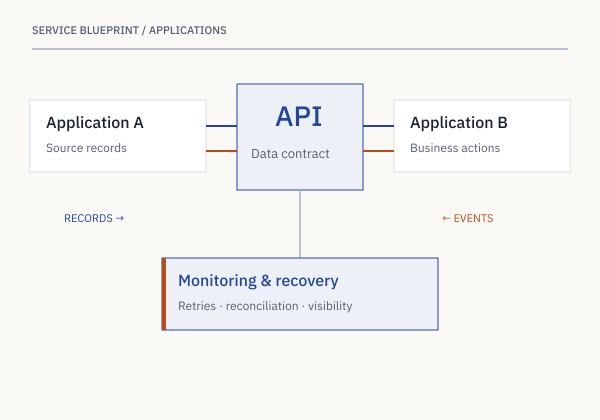
Illustrative engagement model, not a client case study. Scope and delivery responsibilities are agreed for each project.
Illustrative engagement / API & systems integration
Connected applications create the data foundation for analytics and AI. For physical operations, the same integration discipline connects device platforms and cloud applications to the people using them.
How we start
Bring your current environment and the outcome you’re working toward. We’ll use that context to shape the first stage.
Let’s find a starting pointClarify the business need, who the system serves, the constraints, and what a useful result would look like.
Review the data, devices, applications, and infrastructure involved. Identify dependencies before choosing the approach.
Agree on a focused scope, how the work will be evaluated, and the operational responsibilities that follow.
Before we begin
First inspect their supported interfaces, export formats, and vendor constraints. A file exchange or scheduled transfer may be appropriate when an API is unavailable; some systems may require a change before reliable integration is possible.
No. Use the timing the business process actually needs. A scheduled exchange may be sufficient for reporting, while a user-facing action may need an immediate response.
The design should specify timeouts, retries, duplicate protection, visible error states, and a recovery path. The right behavior depends on the consequences of delayed or repeated work.
The wider connection
U.S. presence / Since 2011
From Plainsboro, New Jersey, to Sunnyvale, California, we bring an established U.S. presence to your next technology project. Start with a direct conversation.
West Coast office
100 S. Murphy Avenue, Suite 200Let’s find a starting point
Tell us a little about your project and when you’d like to talk.